


Google Patent Revealed: How LLMs “Understand” Your Brand – And Why Targeted Reputation Management Now Determines Your Economic Success
- Strategic Focus Ranking: Targeted Reviews for More Private Patients


Have you ever wondered how Google decides which practice or business appears at the top of recommendations in the era of artificial intelligence? A recent Google patent titled “Data extraction using LLMs” (Data Extraction Using Large Language Models) now gives us deep, almost alarming insight into the future of search.
We are in the midst of a paradigm shift. The era when you could “feed” Google with simple keywords is over. Today, it’s about so-called “brand encoding.” Google uses LLMs to transform unstructured data—such as your reviews—into a highly complex, structured understanding of your brand identity. In this article, we analyze the patent in detail and show you how ReviewBird positions you precisely at the interface where Google evaluates your relevance.
The 5 Most Important Insights at a Glance:
- LLMs as Digital Archivists: Google uses LLMs not only for chats, but as a primary tool to build structured "entity profiles" from chaotic internet data.
- The Power of "Verticals": Google no longer evaluates businesses as a whole, but divides them into specific service areas (verticals). Being a "good doctor" is not enough; you must be a "good surgeon" in the AI's perception.
- Sentiment is a Ranking Signal: The sentiment (social sentiment) within your reviews is extracted by LLMs and directly linked to your reputation in specific specialties.
- Targeted Data Feeding: The patent demonstrates that Google searches for specific testimonials to validate sub-services. If you don't provide data here, you don't exist for the AI in this area.
- Control as Competitive Advantage: By strategically generating reviews for high-margin services (e.g., private patient areas), you can actively influence the AI's brand understanding in your favor.
The Google Patent "Data extraction using LLMs" – The Anatomy of Understanding
The present patent outlines a technological workflow that forms the foundation for the next generation of Google Search (SGE – Search Generative Experience). While classic algorithms merely matched text patterns, LLMs today “understand” semantic context.
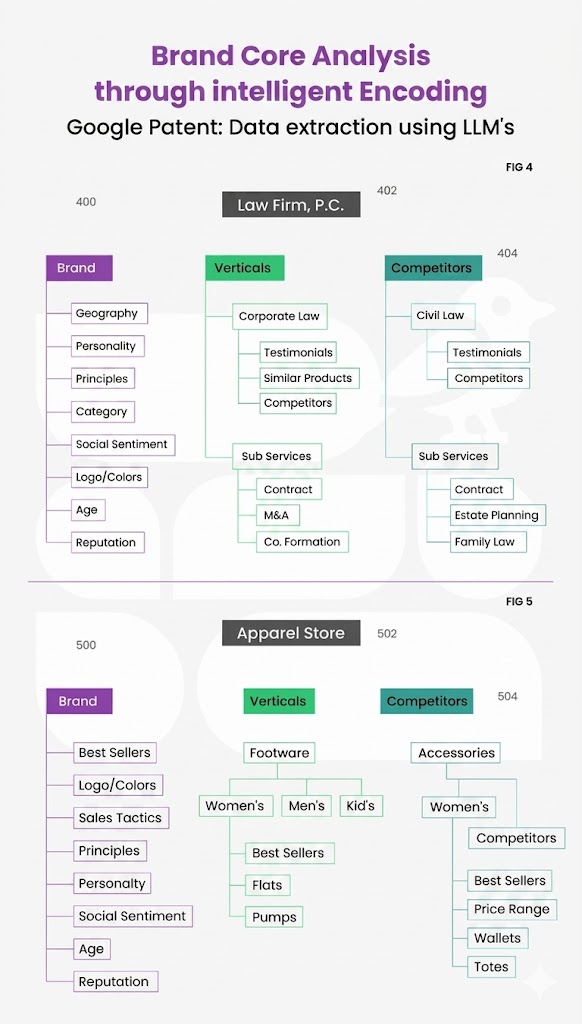
Analysis of FIG 4 & FIG 5: From Name to Entity
In the patent’s diagram, we see two detailed charts: a law firm (FIG 4) and a clothing store (FIG 5). These serve as blueprints for how Google “encodes” every company on the web.
- The Brand Level (400/500): At the top is the company as an entity. Here Google collects basic data such as geography, logo colors, and general categorization. However, the fields “Personality” and “Principles” are already crucial here. Google is attempting to filter out the “character” of your business from your customers’ feedback.
- The Verticals Level (402/502): This is where it gets interesting. A law firm is divided into “Corporate Law” and “Civil Law.” A clothing store into “Footwear” and “Accessories.” The LLM understands that a positive review for one vertical does not automatically mean expertise in another.
- Sub-Services and Specific Reputation: Below the verticals, we find concrete services such as “M&A” (Mergers & Acquisitions), “Estate Planning,” or “Pumps” and “Flats.” The patent explicitly shows connections to “Testimonials” and “Similar Products.” This means: Google searches your reviews for evidence of excellent work in precisely these subcategories.
The patent makes it unmistakably clear: Google aggregates this information to make precise recommendations in the next step. When a user searches for “Best lawyer for M&A,” the LLM scans the extracted data at the sub-service level. If there are no positive signals from reviews there, the firm will not be recommended despite a generally good star rating.
Brand Encoding – Why LLMs "Read" Your Reviews Like a Human
The term “Encoding” in the diagram’s title is no coincidence. In computer science, encoding means converting data into a format optimized for a specific application. In Google’s context, it means: converting human language (reviews) into a mathematical vector that represents your brand quality.
The End of the "Star Hunt"
Previously, the goal was simple: collect as many 5-star reviews as possible. The content was secondary as long as the quantity was right. LLMs have destroyed these rules. An LLM “reads” the text and extracts:
- Entities: Which service is being discussed?
- Sentiment: What is the mood in your reviews? (Enthusiasm, relief, disappointment, criticism?)
- Specificity: Are technical terms mentioned that indicate high service quality?
Social Sentiment as a Core Factor
In FIG 4 of the patent, “Social Sentiment” is directly linked to the brand level. This is a paradigm shift. Google no longer just measures that you exist, but how the world talks about you. When LLMs extract reviews, they build a trust ranking. A company with 100 general reviews will be rated lower by the AI than a company with 20 reviews, 40 of which contain specific, high-quality sentiment about a core vertical (e.g., “Private Cardiology”).
The Relevance for the Medical Sector – Practice Examples
For physicians and medical facilities, this patent is a goldmine for strategic positioning. Let’s assume you run a dental practice. Your goal is to attract more patients for implantology, as this is an economically attractive area.
Scenario A: The "Spray and Pray" Method
You collect reviews indiscriminately. Many patients write: “Nice team, short waiting time.”
- Google’s LLM Extraction: The system classifies you as “friendly” (Personality) and notes “good organization.” However, the profile for the “Implantology” vertical remains empty. In a specific search for implants, you do not appear in the top recommendations.
Scenario B: Strategic "Vertical Encoding" Through Targeted Control
In this case, reputation building is actively controlled. Instead of hoping for random feedback, the focus of review generation is deliberately placed on the “Implantology” area. Patients are motivated to report on their specific experiences in this segment. Your patients now write: “The implant placement was absolutely professional and painless.”
- Google’s LLM Extraction: The LLM recognizes the sub-service “Implantology.” It extracts extremely positive sentiment for precisely this service area. In the brand hierarchy (according to FIG 4/5), the expertise for this vertical is massively upgraded.
The Result: The practice attracts exactly the patients seeking excellence in this area—usually private patients or self-payers who value specialized expertise.
The ReviewBird Feature – Your Control Panel for Google's AI
The patent shows Google’s “desired structure.” ReviewBird is the tool with which you operate this structure. Our feature for enabling and disabling appointment categories is the direct response to the vertical logic of LLMs.
Why Control is the Key to Success
Not every review is equally valuable for your business. A review for a standard service that you perform “on the side” anyway barely advances you economically. A review for a high-end service, however, is like fuel for your ranking in the most profitable niche.
- Strategic Selection: You can decide: “This month I want to strengthen my profile in aesthetics.” You activate the corresponding category in ReviewBird, and your patients receive targeted prompts to report on exactly that.
- Data Purity for the AI: By controlling which areas reviews are collected for, you prevent “dilution” of your profile. You feed the LLM with highly relevant data points for your most important verticals.
- Attracting Private Patients: Private patients often don’t search for the “family doctor around the corner,” but for the “specialist for service X.” By strategically encoding this specialization in the Google system, you become visible to this lucrative target group.
Competitive Analysis Through the Lens of AI
Another fascinating aspect of the patent is the “Competitors” point (404/504), which is directly linked to the verticals. This means: Google uses LLMs to compare you directly with your competitors—at the service level!
The system asks itself: “Who has better sentiment in the ‘M&A’ (or ‘Implantology’) category?” If your competitor has 500 reviews but only 5 about implantology, and you have 50 reviews, 40 of which are about implantology with excellent sentiment, the LLM will classify you as the more relevant expert for this specific vertical.
This breaks the dominance of old, established businesses that may have thousands of old reviews but provide no current, specific data for modern service areas. With the right strategy, “younger” brands can overtake the incumbents through intelligent vertical management.
Practical Steps for Implementation
How do you now use this knowledge concretely? Here is a battle plan for your practice or business:
- Identify Your Core Verticals: Which 20% of your services generate 80% of your contribution margin? (E.g., private services, specialized surgeries, exclusive consultations).
- Audit Your Current Sentiment: Read your last 20 Google reviews. Which verticals are discussed there? If it’s only “friendliness,” you have an encoding problem.
- ReviewBird Category Setup: Enter your appointment categories in ReviewBird.
- Activate the Focus: Actively enable the categories for your core verticals. Ask your team to particularly encourage patients to review after these treatments.
- Monitoring: Monitor not only the number of stars, but watch for Google beginning to display your practice for specific keywords in the “Local Packs.” This is the sign that LLM encoding is working.
Conclusion: Become the Architect of Your Brand Understanding
The Google patent “Data extraction using LLMs” is a wake-up call. We are leaving the era of passive online reputation. In a world where artificial intelligence decides who gets recommended, we must speak the language of AI. And this language consists of structured, specific, and emotionally validated data.
By using ReviewBird to not leave your reviews to chance, but to strategically channel them for your most important service areas, you build a digital barrier against the competition. You help Google understand you as what you are: an expert in your field.
Are You Ready to Strategically Control Your Reputation?
Don’t let an algorithm interpret your brand randomly. Take action and feed the AI with the right information.
Visit us at ReviewBird.io and let us prepare your practice together for the future of search.
How exactly do LLMs influence my ranking in Google Search?
Google uses Large Language Models to semantically analyze and encode the content of your reviews. Instead of just counting stars, the AI extracts specific service areas and the associated sentiment. When your reviews describe detailed positive experiences about certain specialties, Google classifies you as a more relevant expert for precisely these specialties and displays you higher.
What is the difference between classic Google algorithms and LLM data extraction?
Classic algorithms searched for direct keyword matches and quantitative signals such as backlinks. LLM data extraction, however, understands the context and structure of a business, as outlined in the Google patent. The AI can extract implicit information about your service quality and brand personality from texts that were previously invisible to algorithms. This makes the quality and specificity of your reviews more important today than pure quantity.
Can I really attract more private patients through targeted reviews?
Yes, absolutely. Private patients frequently search for specialized excellence for specific treatments. When you use ReviewBird to strategically generate reviews with positive sentiment in these categories, Google’s LLM recognizes this expertise. You therefore appear preferentially in search results for specialized, high-value services, which appeals to exactly the target group willing to pay privately for above-average quality and expertise.
Is it risky to disable certain appointment categories for reviews?
Quite the contrary: it is a strategic optimization. When you disable categories for standard services, you concentrate the attention of your patients and Google’s AI on your most lucrative and important specialties. This prevents your brand profile from being diluted by irrelevant or superficial information. This leads to a sharpened expert profile in terms of brand encoding, which Google needs for precise recommendations.
How long does it take for Google to recognize the new brand encoding?
The updating of brand understanding by LLMs occurs continuously. As soon as new, high-quality, and specific reviews for your target verticals arrive, the AI begins integrating this information into your entity profile. Typically, initial changes in visibility for specific specialty queries can be observed after just a few weeks, provided a steady stream of relevant data is ensured through tools like ReviewBird.

Founder, Managing Director ReviewBird
Timothy Scherman is an experienced SEO expert and digital marketing consultant with over ten years of expertise in online marketing. As founder of Doc Marketing, he supports physicians and medical facilities in increasing their visibility and successfully attracting new patients.
Founder, Managing Director
ReviewBird


